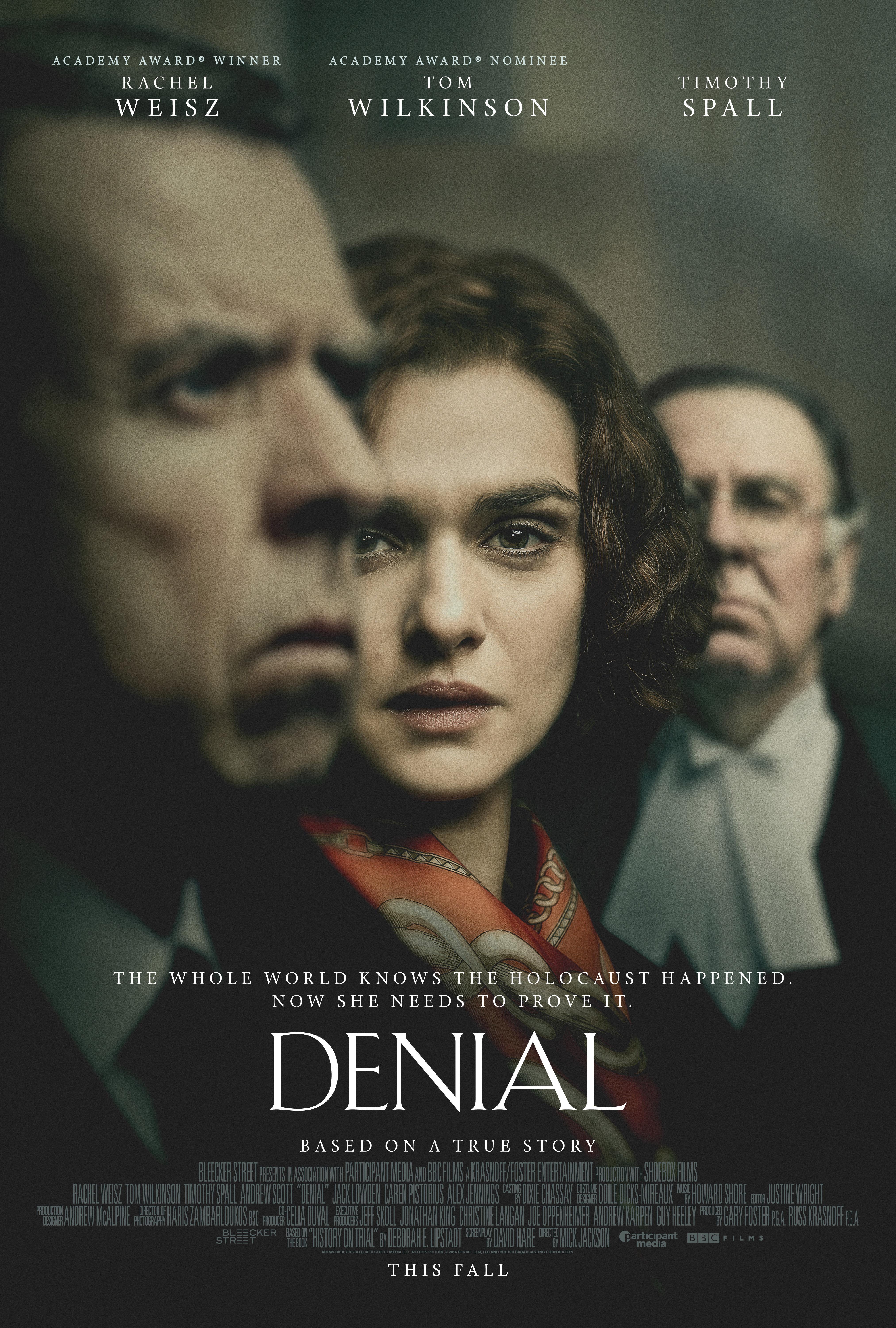
This is a fine film. Full credit to a great cast, the director Mick Jackson and the distinguished playwright David Hare for his screenplay.
Despite knowing the outcome, I found the courtroom scenes really thrilling, and when Mr Justice Gray (Alex Jennings) asks whether David Irving (Timothy Spall) might not have denied the Holocaust in good faith the shock is quite electrifying.
The tensions between Deborah Lipstadt (Rachel Weisz) and her legal team are very intense; the solicitor Anthony Julius (Andrew Scott) appears rather arrogant and high-handed but it becomes clear that (to quote Hamlet) he's being 'cruel only to be kind'. This redeems the soap-opera touches, as I see them, in their exchanges. It's understandable that Lipstadt should find the lawyers' strategy perplexing.
Similarly, the brilliance of Richard Rampton QC (Tom Wilkinson) in court offsets a tendency towards caricaturing him as a bibulous lawyer with a fund of legal anecdotes.
In Timothy Spall's portrayal Irving, representing himself in court, seems dogmatic and devious yet by no means confident of victory. Though clearly concentrating hard, he looks pretty confused. His exchanges with the historian Sir Richard Evans (John Sessions) are embarrassingly unconvincing. At one point he says 'I'm not a Holocaust historian.' That isn't a confession, just an attempt to duck an awkward question from Evans. There's more embarrassment when he tries to look like a good loser.
Only one Holocaust survivor appears in the film: a woman who begs Lipstadt to enable her to testify. Others must have been in court as well, but the woman has a symbolic role. Though unable to grant her wish, Lipstadt assures her that 'The voice of suffering will be heard.' Those words are profoundly moving.
The voice of suffering was indeed heard. Unfortunately, as James Libson (Jack Lowden), a junior lawyer at the time, has remarked, the longer-term consequences ran counter to expectations. Holocaust denial has spread through the internet and Irving claims, chillingly, 'Interest in my work has risen exponentially in the last two or three years. And it's mostly young people.' ('The Observer', 15 January 2017)
Neo-fascist and similar movements are growing across Europe, no doubt encouraged by Donald Trump's election in the USA. 'Denial', then, is also a terrible warning. It teaches a lesson from contemporary history (in 2000) as well as history in the broader sense – at least for those able to learn.
Against the dark decor of the lawyers' offices and the courtroom there are some lighter touches with local colour from London. One long scene, however, takes place at Auschwitz.
عرض المزيد