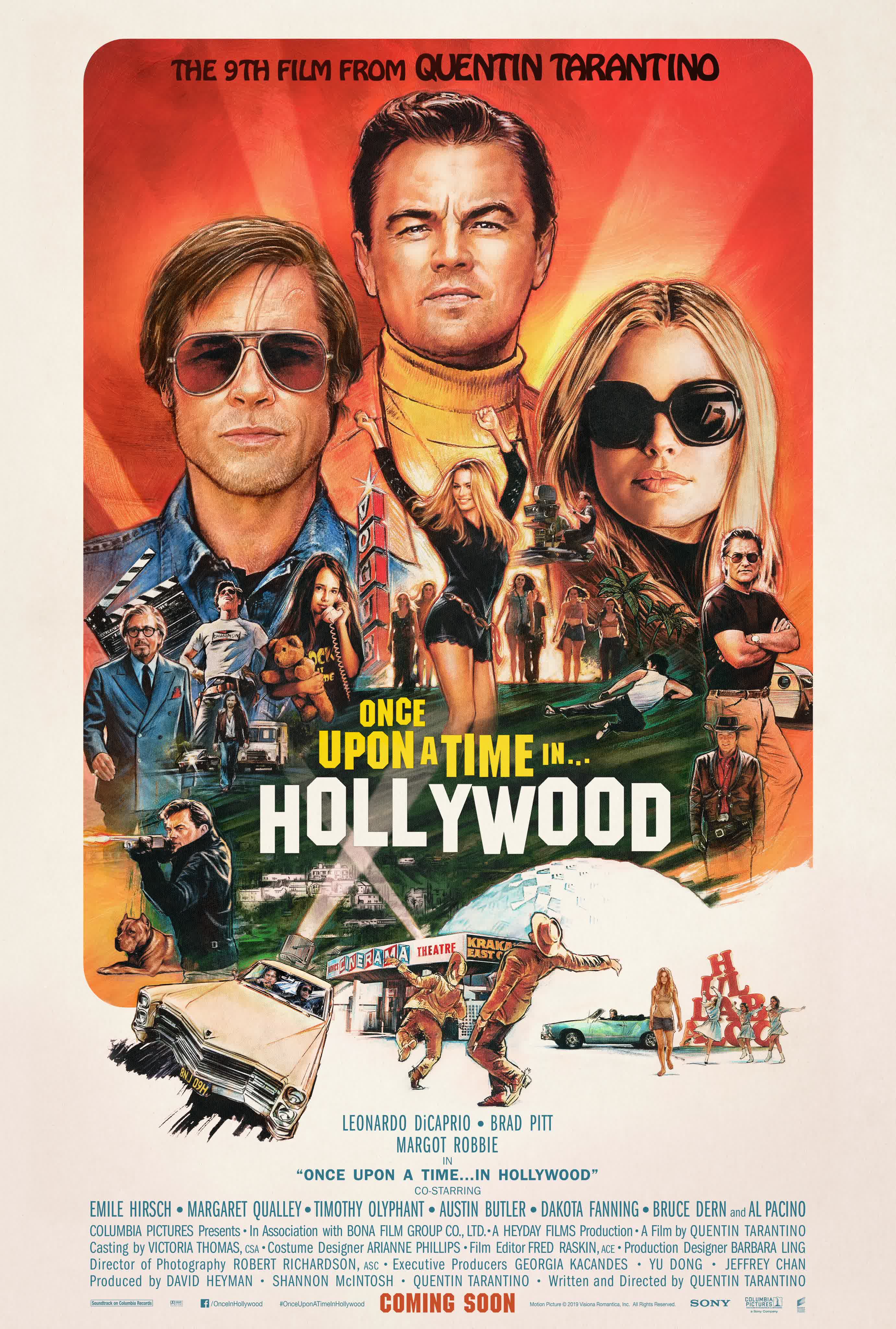
I don't know why critics are being so harsh on the ending. For me, and for most people/fans I feel, it was awesome! Tarantino's always been a collage artist, a man cobbling together new stories from shards of the odd bit of cult culture here and there, and Hollywood sees him fully embracing that mode.
This approach lets Tarantino cut loose, which is probably to the film's benefit, especially as we center on DiCaprio and Pitt as his leads. It's a bizarre thing to see former teen heartthrobs like these two suffer and flail about their closing careers, or to hear so many people call Pitt's character "old." (As one shirtless scene shows us, even old Pitt can still get it.) Of the two, Dalton has a harder time with it, his ego comically wrapped around the idea of his career fading. In one of his latest guest stints as a heavy on a Western, he connects briefly with his precocious eight-year-old co-star (an unstoppable Julia Butters) who reinvigorates his confidence as an actor, especially after an explosive breakdown in his trailer.
DiCaprio is having particularly garish fun here, ripping into his signature Jordan Belfort-era intensity and turning his washed-up TV star into a petulant, gurning child, as you do when you're forced to contemplate cranking out spaghetti Westerns in Rome to keep your career afloat. On the other end of the spectrum is Pitt, all Southern drawl and stoicism, the kind of unstoppable Billy Jack figure who can fight to a draw with Bruce Lee (Mike Moh) and even hold his own in some tense confrontations with the Manson family. The two are gangbusters together, evincing even in their quiet moments the camaraderie of two men who've spent their lives together, Cliff being "more than a best friend and a little less than a wife" to Rick. They shine even when they split apart for their separate stories - Rick's guest spot on Lancer and Cliff's unexpected detour to the Manson Ranch - but each feels of a piece with the other.
As for the Mansons themselves, they play a much more peripheral part in Hollywood than one might expect from a gore-lover like Tarantino. Instead, they're another layer to the gonzo tapestry he's woven, a group of young nutcases who've taken over Spahn Ranch (where the fictional Bounty Law was shot) and who give the older Cliff no amount of discomfort. They're a group of kids resentful of the largesse of Hollywood, who want to "kill the people who taught us to kill" through violent TV shows and movies; as one of cinema's foremost purveyors of bloodshed, it's a bold move for Tarantino to take.
And yet, that self-reflexivity beats at the heart of Once Upon a Time in Hollywood, a film made by a man who sees his own obsolescence coming. Just as Cliff and Rick barrel inexorably toward the "end of the trail" for their partnership and the era of Hollywood that would take them in, so too does Tarantino see the same for himself. It's tempting to read it as an "old man yells at cloud" feature, with its characters' many resentments toward young bucks taking their jobs. But it's just as easy to imagine Tarantino owning up to the limitations of your age and range, instead tipping his hat and riding off into the sunset. He's got one more film in him, but even if this were Tarantino's swan song, it wouldn't be a bad note to go out on.