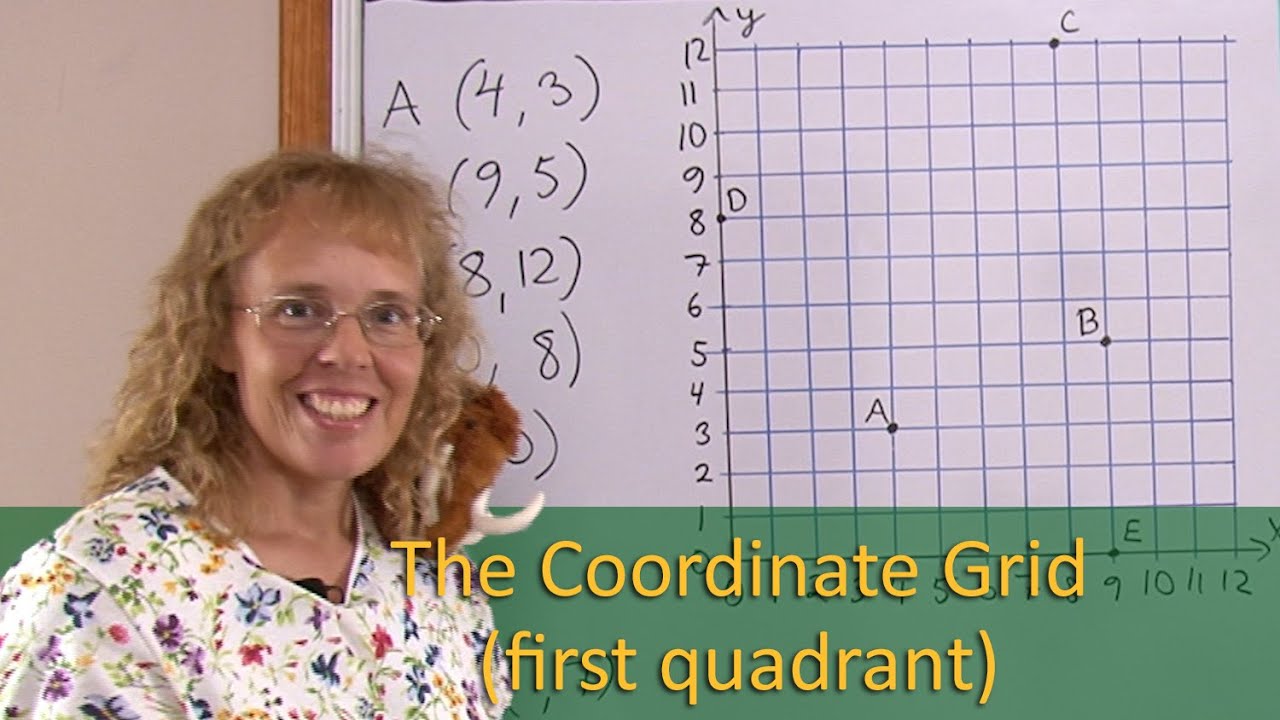
We look at two numerical (linear) patterns created by adding or subtracting the same number (the rule), and their graphs in the coordinate grid. For example, if we add 1 to the x-coordinate and add 2 to the y-coordinate, and plot the points, the resulting graph looks like dots on a LINE - thus the name "linear" pattern. In algebraic terms, in this case, y = 2x, or every y-coordinate is double the x-coordinate. If we subtract the same amount from the y-coordinate each time, (and add some same amount to the x), we get a descending line. Then, I show some linear patterns of dots in the coordinate plane, and the task is to figure out the NUMERICAL patterns for the coordinates. It turns out, we can also visualize the rule for the patterns. For example, if the rule for x is "add 3" and the rule for y is "add 2", we can draw a staircase, just like when determining a slope of a line... the run is 3 units and the rise is 2 units. This lesson covers the common core standard 5.OA.3 about two nume
Tingnan pa